Product Tour · 2026

This is Allot, in Screenshots

A private, offline-first budget app that lives entirely in your browser. No account, no subscription, no data leaving your device. Here's everything it does — one screen at a time.

Most budgeting apps ask for an email, a password, and read-only access to your bank before they'll show you a single number. Allot doesn't. You open a web page and you're budgeting — your transactions are stored in your own browser, and nothing is uploaded unless you deliberately turn on encrypted sync.

That privacy model doesn't cost you features. Allot does envelope budgeting, multi-account tracking, CSV bank import, spending reports, and net-worth tracking — and it installs on your phone as a real app that works with no signal. The best way to show that is to just show it. Let's walk through the app.

1

Set up in about five minutes

A three-step wizard gets you from cold start to a working budget. Pick your currency, name your first account, drop in a balance — that's it. No email, no password, no card. You can add more accounts and categories any time.
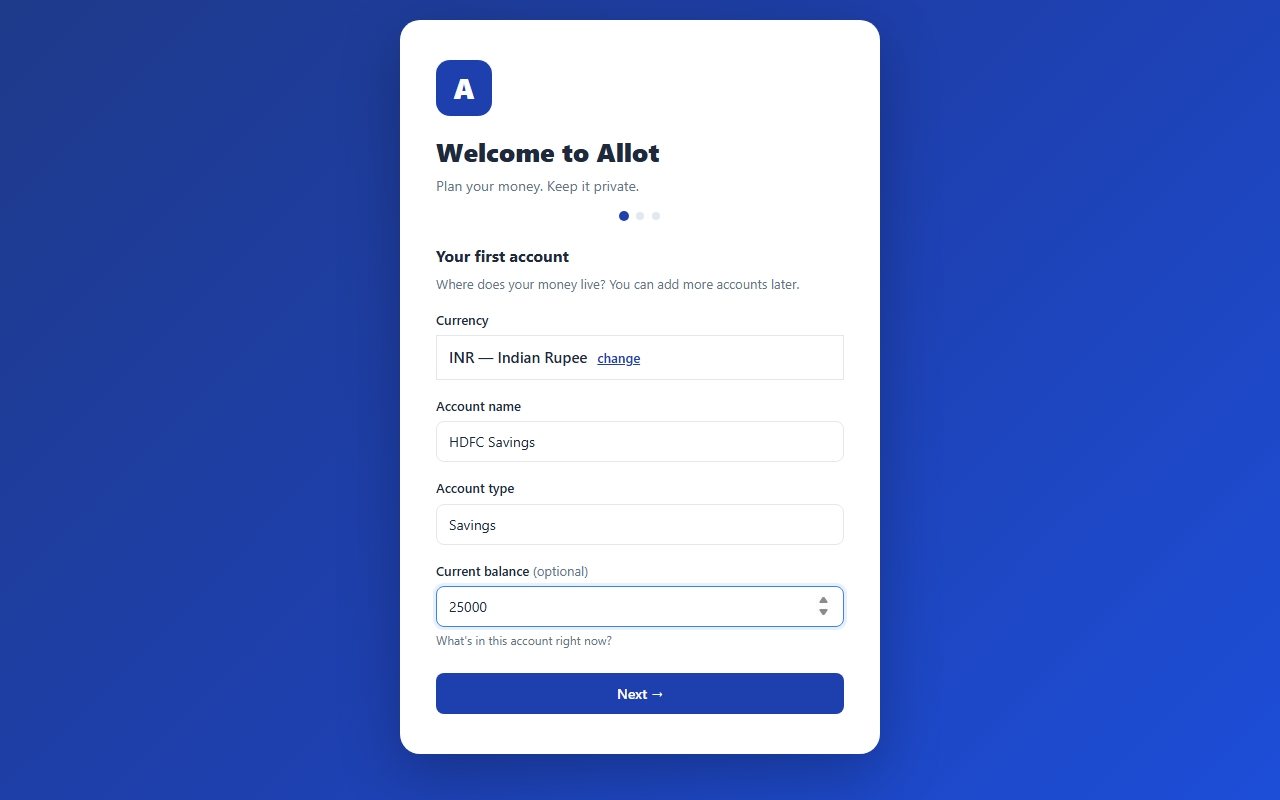
Allot onboarding wizard: choose currency, name your first account, and enter a starting balance
Step one of onboarding — currency, account name, type, and an optional starting balance. Nothing here identifies you.
2

Envelope budgeting that actually clicks

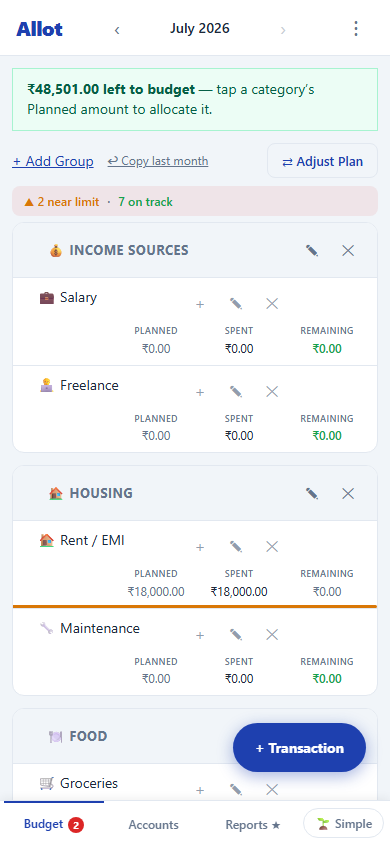
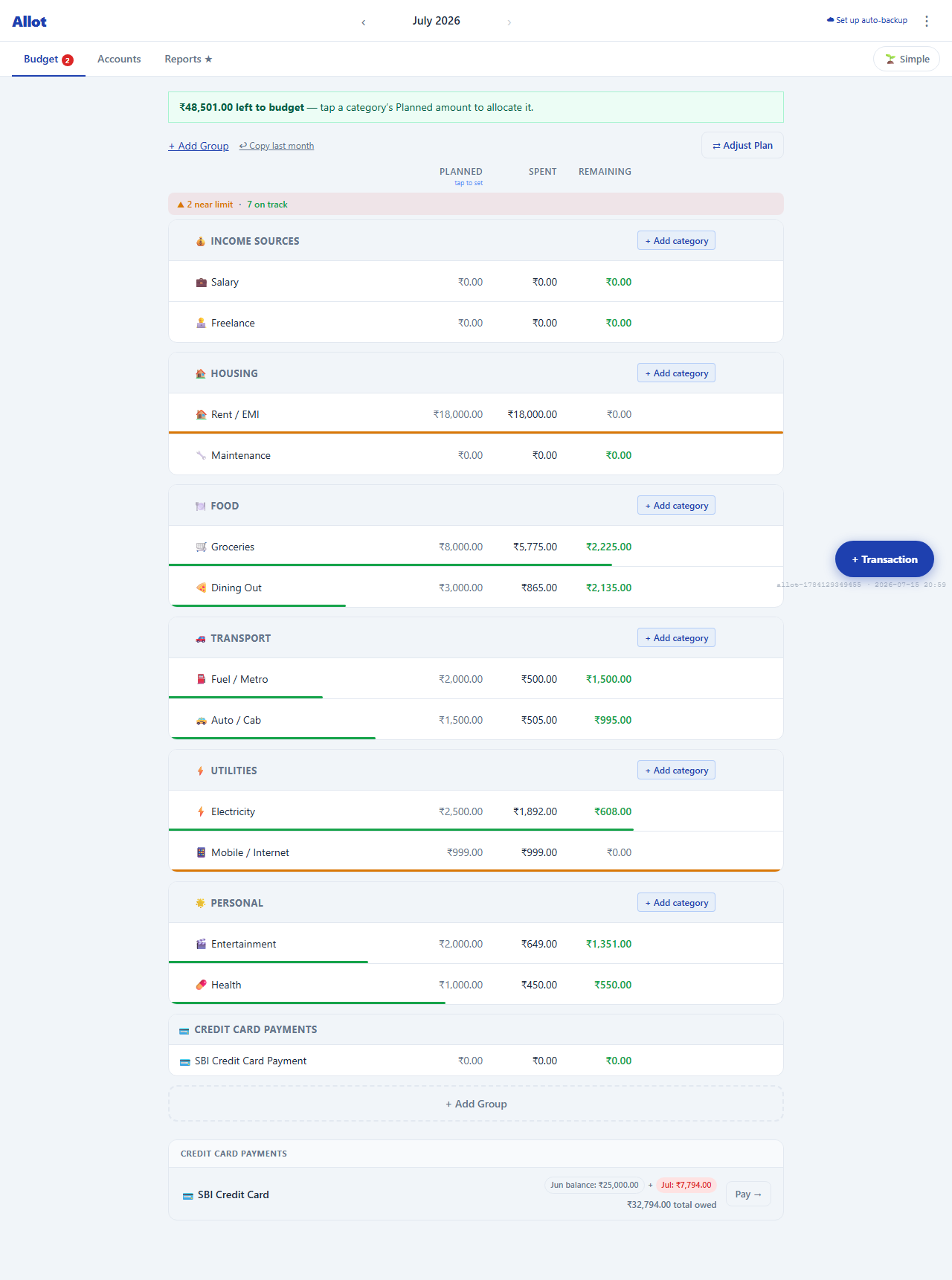
Give every rupee a job. Money is split into category groups — Housing, Food, Transport, Utilities — each with a Planned, Spent, and Remaining figure. A coloured bar under each category tells you at a glance whether you're on track, near the limit, or over.

Allot budget view showing category groups with planned, spent and remaining amounts and on-track progress bars
The monthly budget. "₹48,501 left to budget" up top, per-category progress underlines, and a dedicated credit-card payment section that tracks what you owe.

Prefer it simpler? One tap flips the whole screen to a single "Safe to Spend" number — ideal if envelope tables feel like too much. The detailed view is there when you want it.

3

Log spending in seconds

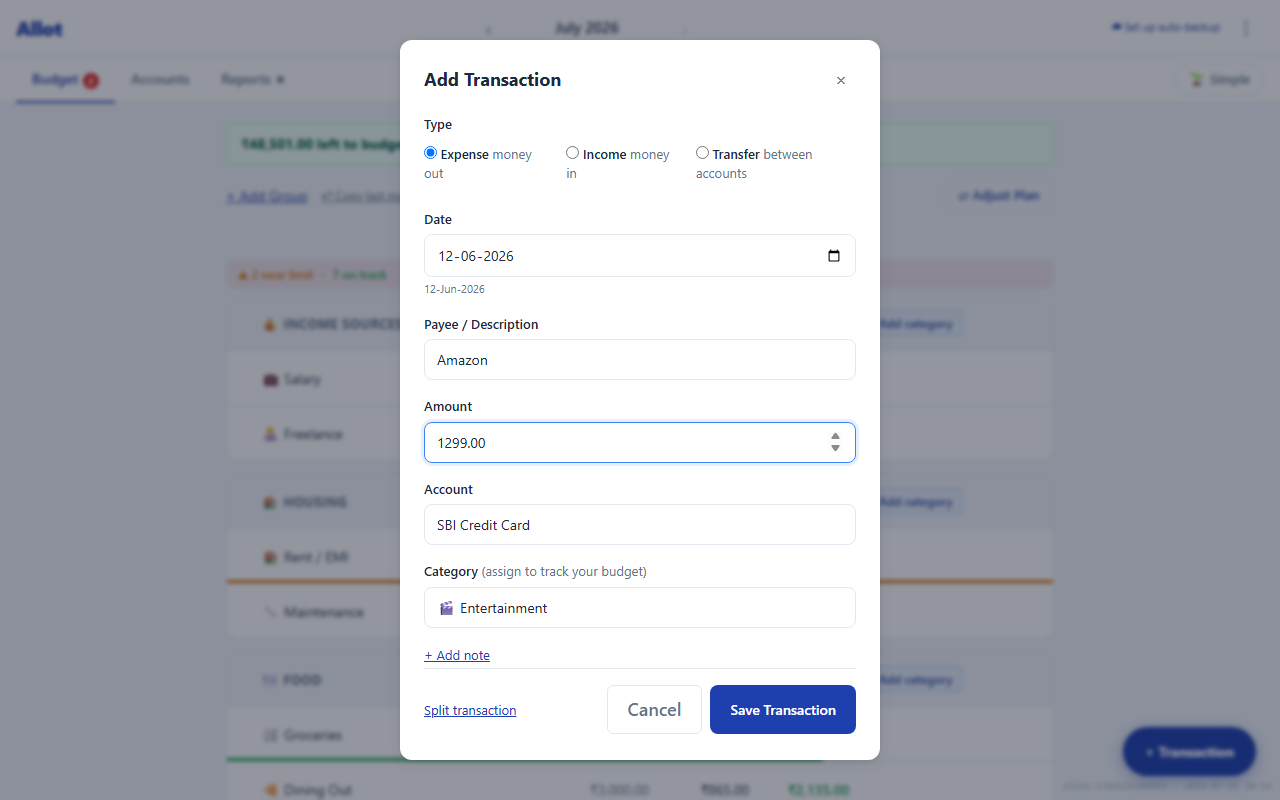
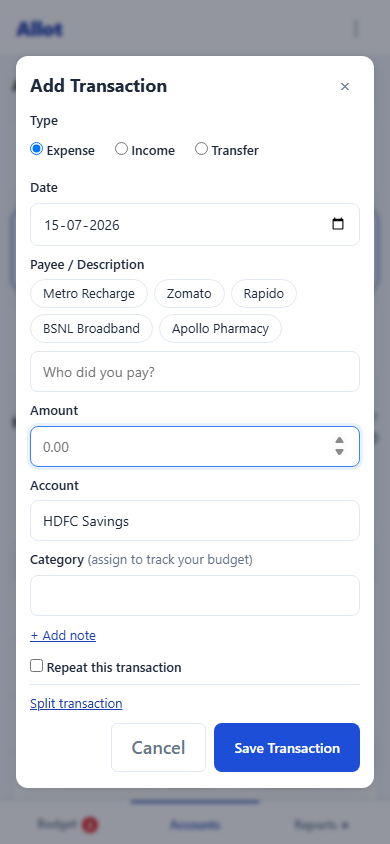
The add-transaction box opens with the amount field already focused. Type the number, the payee, pick an account and category, and save. Handle expenses, income, and transfers between accounts — plus split transactions and recurring entries — all from the same place.

Allot add-transaction modal with expense type, payee, amount, account and category filled in
Adding an expense. Auto-categorisation learns your payees over time, so repeat entries pre-fill the category for you.
4

Every account, one net-worth number

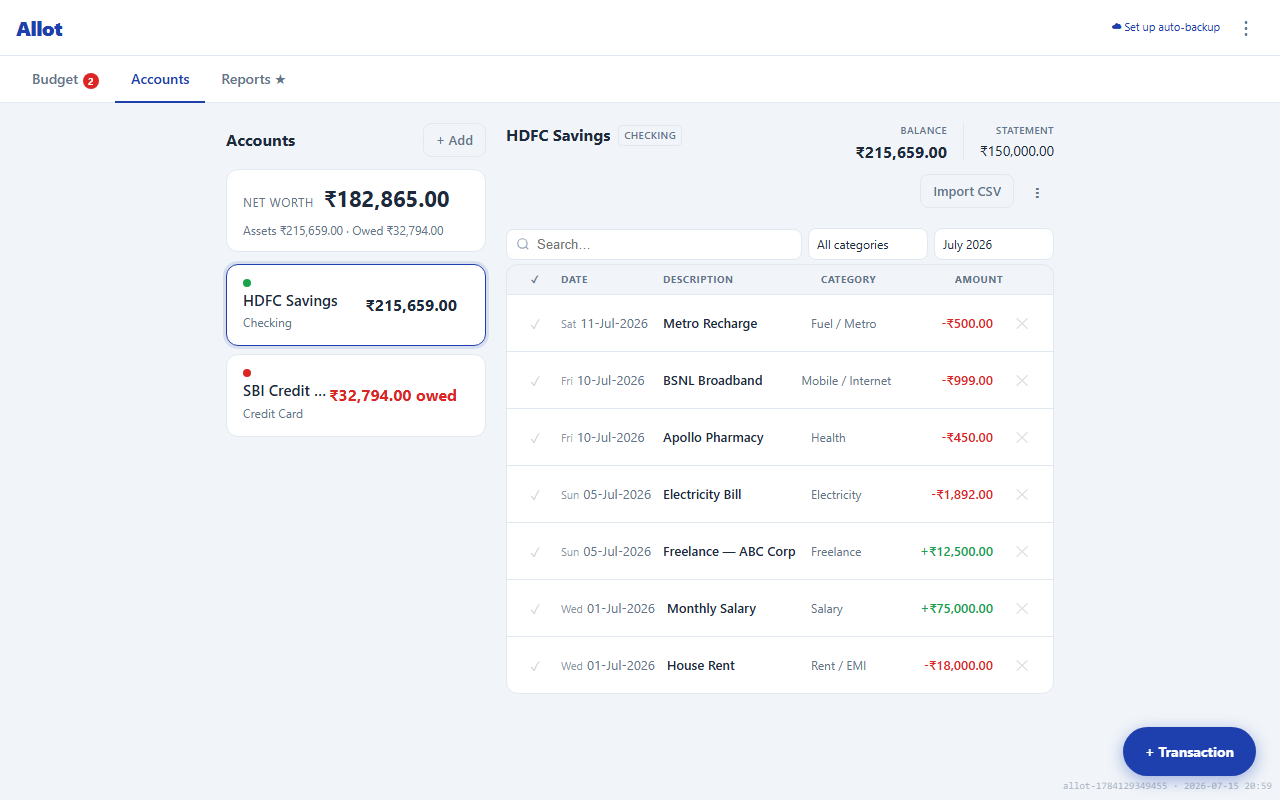
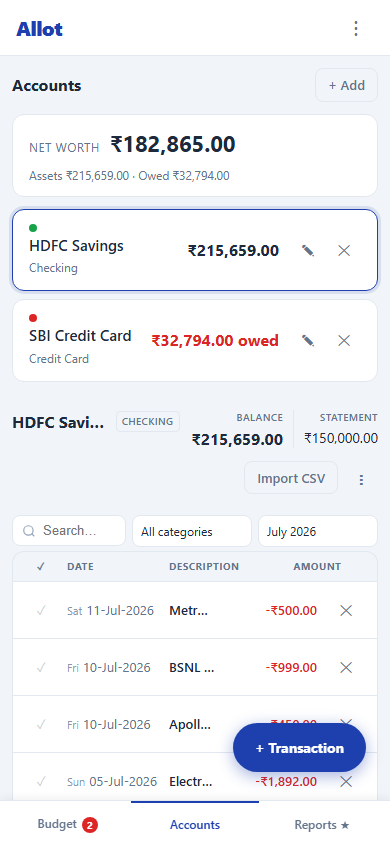
Track current accounts, savings, cash, and credit cards side by side. Allot rolls them into a single net worth figure — assets minus what you owe — and gives each account its own searchable, filterable transaction register.

Allot accounts view with net worth, account list, and a filterable transaction register
Accounts view — net worth top-left, accounts down the side, and the selected account's transactions with search and month filters.
5

Import a statement from any bank

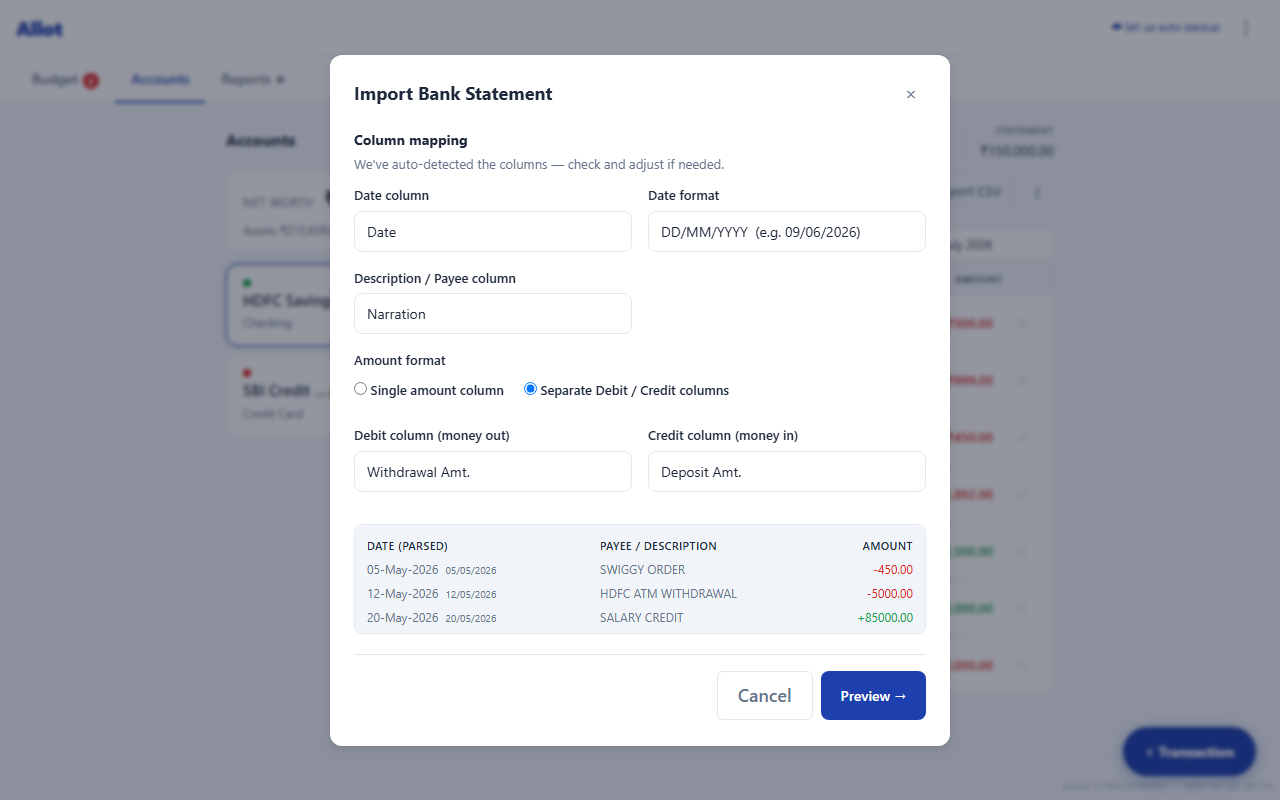
No fragile bank connections to break. Export a CSV from your bank and drop it in. Allot auto-detects the columns — date, description, debit/credit — and shows a live preview before anything is imported. It handles statement formats from Chase, Barclays, HDFC, CommBank, and hundreds more.

Allot CSV import: column mapping with auto-detected date, description and debit/credit columns and a live preview
The import wizard auto-maps your columns and previews parsed rows, so you catch mismatches before they hit your books.
6

See exactly where your money goes

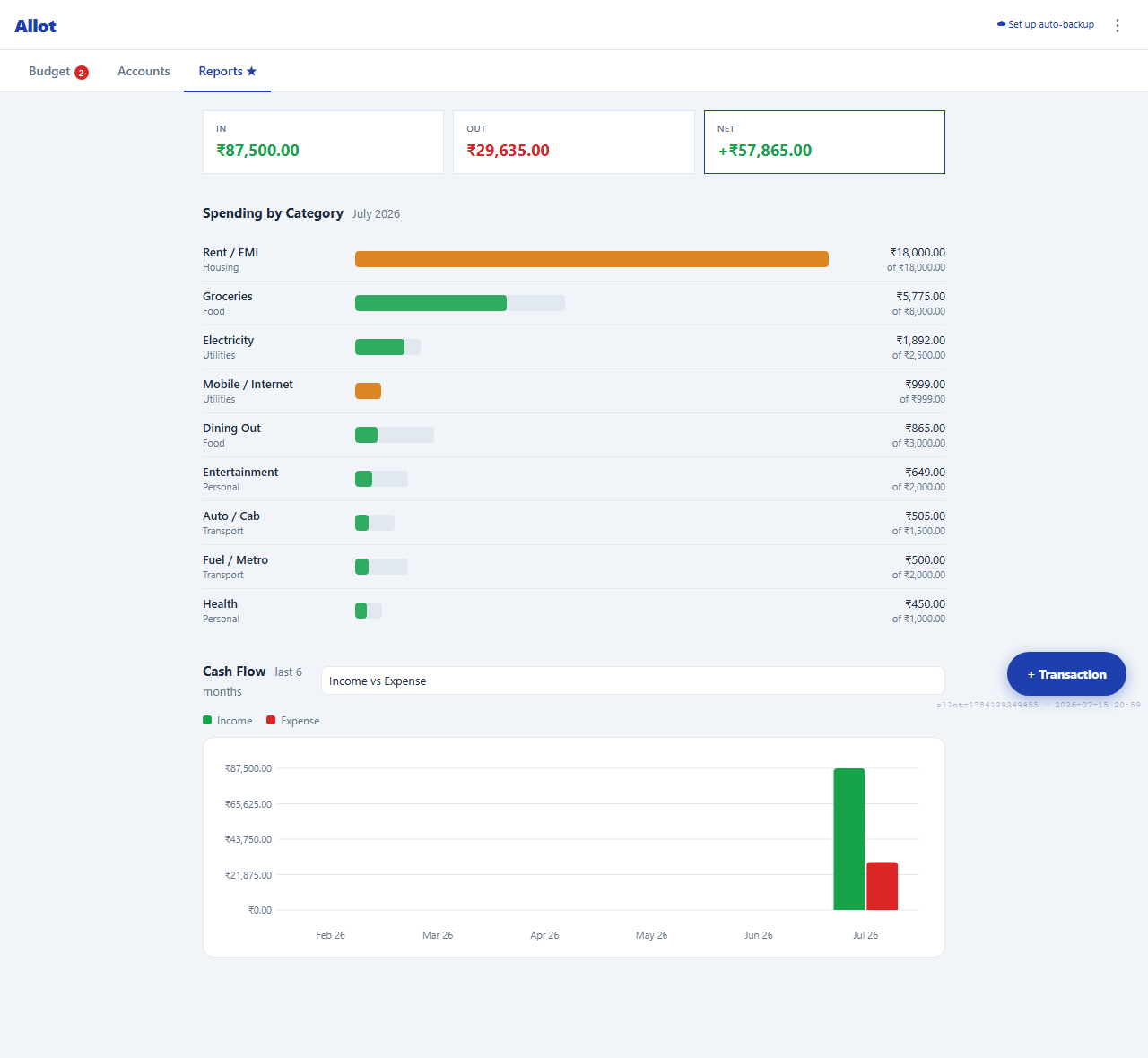
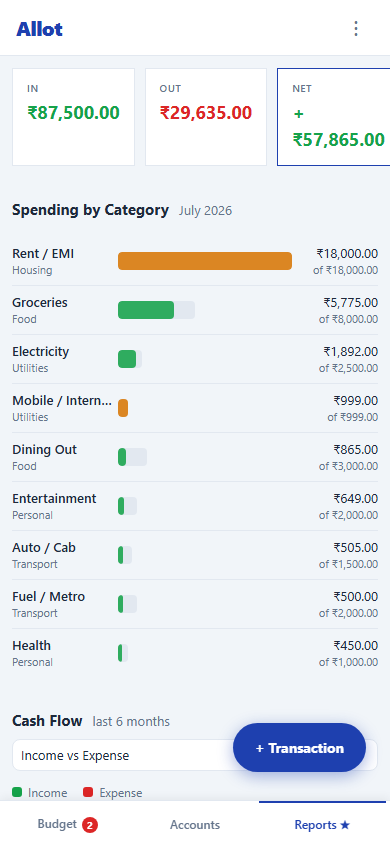
Reports turn a month of transactions into answers. Money in vs out vs net at the top, spending broken down by category against its budget, and a six-month income-vs-expense cash-flow chart to spot the trend.

Allot reports: income, expense and net totals, spending by category, and a six-month cash flow chart
Reports view — category spend bars go amber when you cross the planned amount, and the cash-flow chart shows income against expense over time.
7

Your whole budget, in your pocket

Allot is a Progressive Web App. "Add to Home Screen" and it installs like a native app, with a thumb-friendly bottom tab bar and full offline support — every core feature keeps working with no signal. Same data, same app, just sized for a phone.

Allot budget view on a mobile phone
Budget
Allot accounts view on a mobile phone
Accounts
Allot add-transaction screen on a mobile phone
Add a transaction
Allot reports on a mobile phone
Reports

The part that makes Allot different

Everything above runs entirely in your browser. There's no Allot account, because there's no server holding your budget. Your transactions live in your device's local storage and go nowhere by default.

If you want your budget on more than one device, you can turn on Cloud Sync — and even then, your data is encrypted on your device with AES-GCM-256 before it ever leaves. The sync server only ever stores ciphertext; it never sees a payee, an amount, or a category. Privacy isn't a setting you switch on later. It's the default, and it's the architecture.

✉️

No account

No email, password, or sign-up. Open the page and start.

🔒

Data stays local

Stored in your browser. Optional sync is end-to-end encrypted.

📴

Works offline

Full PWA — budget on a plane, sync later.

💸

$19, once

One-time price. No subscription, ever.

See it with your own numbers

The full app opens in your browser right now — no account, no credit card, no email address. The screenshots above are the free tier.

Try Free — No Sign-Up → Buy Premium — $19 once